Chef Andrew Hunter is a culinary innovator and product developer known for transforming creative food concepts into scalable products for global brands, including Wolfgang Puck Worldwide, Niman Ranch, and Kikkoman. Blending culinary expertise with a passion for storytelling, he develops products that balance flavor, cultural integrity, and consumer appeal. Be sure to follow him on Instagram.
You’ve built a career at the intersection of culinary creativity and product development, how do you balance innovation with scalability when creating food for global markets?
I constantly ask myself how I make the most craveable food that engages people’s senses. While there are different considerations when innovating in a restaurant kitchen versus a manufacturing kitchen, the core challenges are the same. Scalability is simply innovating with precision. I only cook freestyle at home. At work, I precisely record weights, taste constantly, and pay close attention to percentages. Scaling formulas isn’t straight math because there are certain ingredients that behave differently in volume than they do on the bench, so it’s important to have faith in the math and respect the nuance. Creating food for global markets with different taste sensibilities demands a kind of humility and patience.
With roles spanning Wolfgang Puck Worldwide, Niman Ranch, and Kikkoman, how do you adapt your development approach across such different brands and audiences?
It starts with listening. The more I understand a brand, its audience, and its values, the easier it becomes to create products that feel authentic to who they are. I never try to force a concept that falls outside a brand’s identity, but that doesn’t mean established brands can’t be disruptive. In fact, innovation is often essential for survival.
I like to compare product development to architecture. Two architects can be given the same plot of land, yet one designs something predictable while the other creates a structure that is dynamic and memorable. Both respect the boundaries, but one is far more compelling. Product development works the same way. It’s not about thinking outside the box, it’s about being creative within it. The brand defines the boundaries, and the challenge is finding innovative ingredients, techniques, and ideas that bring that brand to life in new and exciting ways.
You often translate raw agricultural commodities into foodservice-ready products—what’s the biggest challenge in bridging the gap between farm and finished product?
There’s a misnomer that all produce raised on a farm is beautiful and ready-to-eat. The reality is very different. My mission is to help farmers create systems to help them grow consistent products that meet R&D specifications. This includes the importance of crop rotation and harvest methods. If we connect the art and science of farming and cooking together our finished products are bound to be superior.
How do you see the future of plant-based flavor evolving beyond meat alternatives?
Meat alternatives as analogues are probably entering their twilight era. Instead, people are looking for plant-based foods made with earth-grown ingredients. I’ve developed a range of what I call “similes” that can be enjoyed by herbivores and omnivores alike because they’re similar to the meat version but are vegetarian.
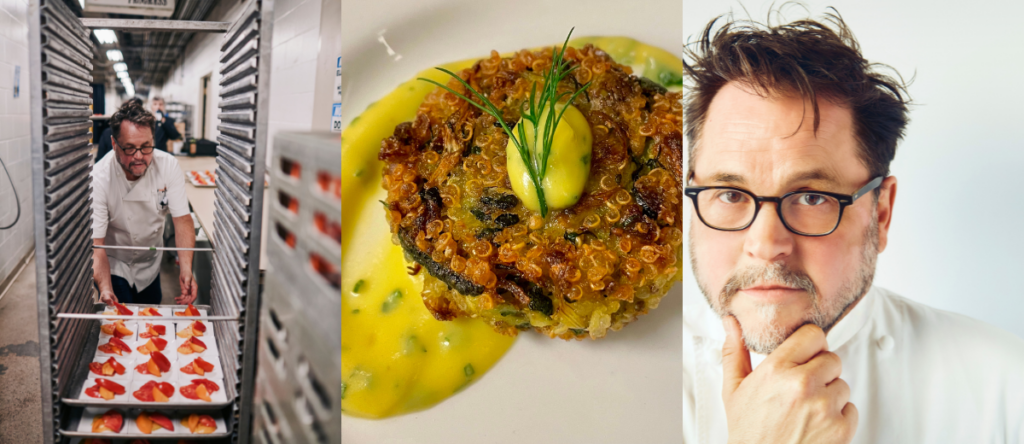
The “crab cakes” pictured here are one of my “similes”. They’re made with roasted and shredded artichokes, fennel and onions and folded with smashed cannellini beans. Kombu and mirin are added for their briny and fermented notes with lots of fresh herbs and citrus zest. The quinoa coating lends a crunchy texture and golden color when the cakes are pan-fried. Plant-based béarnaise completes the plate.
How do regional tastes and cultural expectations influence your R&D process?
Tastes and expectations are the trickiest considerations to navigate. Calling prepared foods authentic is a recipe for failure. The reason is authenticity is deeply personal and subjective. A beautiful example is the scene from Ratatouille when the restaurant critic, with his first bite, is transported back in time to the love and comfort of his mother’s kitchen. This rarely happens because our idea of what we perceive as authentic is personal to us. Instead of authenticity, I encourage my clients to be guided by integrity. This should include understanding a food’s purpose, respecting its origin, selecting the right ingredients and cooking methods, and never naming a product after a place because it will always lead to opposition. The wrong name can doom a product before it lands on menus and shelves.
Having appeared on shows like Supermarket Superstar and Restaurant Startup, what do you think most entrepreneurs misunderstand about bringing a food product to market?
Entrepreneurs typically misunderstand and minimize the complexities and expenses associated with bringing a product to market. These challenges are compounded by having to create the brand at the same time. It can take years and mountains of money to turn a dream into reality, even when it isn’t your first try. My job is to clearly communicate the challenges and to accept that most people or clients will walk away. The reward of success, however, likely comes to those who persevere.
With your background in culinary arts, history, and museum studies, how has storytelling shaped the way you approach menu and product development?
I’m a dreamer and an idealist at heart. Who else would pair culinary history and museums studies together with cooking? I believe my appreciation for humanities and history have built a thought foundation that differentiates me from other chefs. I spend time every morning writing about any number of subjects, most of which will never be read by anyone but me. I write because it starts my day with creative thinking, which is akin to storytelling. Transitioning creative thinking from the notepad to the bench is easy and natural. It also helps me challenge culinary boundaries while achieving operational and business objectives. Ultimately, I have confidence that the food I develop is production-ready, has cultural integrity, and is delicious. I have also come to accept that perfection is never accomplished, and certainly not with the first few tries. Research and development is trial and error, adjustment, and perseverance.